
If you’re leading a technical team, there’s a decent chance your engineers or scientists are holding back their best ideas. Strategies for building psychological safety will show you how to support your team so that they’re not staying quiet about mistakes, or just not comfortable asking questions, or even challenging a questionable approach when they need to.
That silence? It can kill innovation and let tiny issues snowball into real problems.
Psychological safety means your team feels okay taking risks, owning up to errors, and voicing concerns—without worrying they’ll get embarrassed or punished. In technical environments, where the stakes are high and everything moves fast, people often shy away from admitting mistakes or floating new ideas. That’s just human nature, but it’s not great for progress.
As a technical leader, you can build trust and spark innovation by making your team feel comfortable being open. You can figure out where your team stands, learn about the stages of psychological safety, and use practical strategies to help your folks perform at their best.
Building Psychological Safety and Why It’s a Big Deal
Psychological safety shapes how team members interact, take risks, and offer ideas. It decides whether your engineers will flag bugs before launch—or just stay silent to avoid looking silly.
What Is Psychological Safety?
It’s the belief that you can speak up, ask questions, admit mistakes, or pitch new ideas without worrying about embarrassment, rejection, or punishment. When a team is psychologically safe, people feel comfortable being themselves and taking interpersonal risks.
Amy Edmondson, a Harvard Business School professor, coined the term back in 1999. She called it a shared belief that the team is safe for interpersonal risk-taking. So, your developers can question architecture decisions without fearing backlash.
In technical teams, this means junior devs can ask “dumb” questions at code review. Senior folks can admit they don’t get a new framework. People can report security bugs—even if they made them—without worrying about getting fired.
Where Did the Concept Come From?
Edmondson stumbled on psychological safety while digging into medical errors in hospitals. She figured the best teams would report fewer mistakes. Turns out, the most effective teams actually reported more—because they felt safe admitting them.
Google’s Project Aristotle looked at 180 teams to figure out what makes a team great. Psychological safety came out as the top factor—way above technical skills or structure. Teams with high psychological safety just outperformed the rest, period.
So, your team’s ability to innovate depends more on psychological safety than on hiring rockstars or buying fancy tools. That’s not just theory; it’s backed by research as recent as 2022, confirming Edmondson’s findings still hold up in today’s fast-moving tech world.
Common Misconceptions
Psychological safety isn’t about avoiding tough conversations or dropping your standards. You can still give direct feedback and expect high-quality work while building safety.
It’s not about being nice all the time. Debate, challenge, and disagreement are healthy—just without personal attacks or fear of payback.
People often get it twisted:
- It’s not just comfort: Real safety lets you have honest, even uncomfortable, conversations.
- It doesn’t erase accountability: High standards and psychological safety go hand-in-hand in the best teams.
- It isn’t automatic: Leaders have to actively create and protect psychological safety by how they act.
The Role of Leadership in Building Psychological Safety
Leaders set the tone for whether people feel safe to speak up, share ideas, and take risks. The way you act and talk shapes the trust level in your technical teams.
Key Leadership Behaviors
Building psychological safety means you need to show three leadership styles: supportive, consultative, and challenging. Supportive leaders care about their team as people, not just as workers. That means checking in on well-being, not just output.
Consultative leaders ask for input and actually consider it before making decisions. If you’re about to change a process or pick a tech stack, get your team’s opinions first.
Challenging leadership pushes people to stretch, but only works if you’ve already built trust. If you skip the support and consultation, challenging just feels harsh and backfires.
Authoritative, command-and-control leadership? Research keeps showing it kills psychological safety. Move away from dictating and toward collaborating—it’s not just trendy, it’s proven.
Modeling Vulnerability and Admitting Mistakes
When you admit mistakes, you show it’s safe for others to do the same. Technical leaders who show vulnerability create a space where people can acknowledge errors before they get out of hand.
Share your learning moments—recent failures or things you don’t know. Maybe say, “I don’t know the answer to that” or “I picked the wrong database last quarter.” It’s not about looking incompetent, it’s about being real.
You can admit uncertainty and still lead. If you realize you were wrong about a technical choice, tell your team and explain what you learned. This is huge in tech, where mistakes are inevitable. Your honesty gives others permission to surface issues early.
Active Listening and Open Communication
Active listening means giving your full attention, not just waiting for your turn to talk. Ask clarifying questions, and repeat back what you heard to make sure you got it right.
Open communication means having lots of ways for people to give feedback. Hold regular one-on-ones, keep your door open, and encourage questions during discussions.
When team members challenge your decisions, respond without getting defensive. Thank them for raising issues before you dig into the details.
Give feedback about behaviors and outcomes, not personalities. Instead of “you’re not detail-oriented,” try “the last three code reviews missed some error handling edge cases.”
Make space in meetings for quieter folks. Invite those who haven’t spoken, and don’t rush people into answering on the spot.
Establishing Trust, Norms, and Team Culture
Trust grows when leaders set clear expectations and walk the talk on inclusion. Teams work better when everyone knows the ground rules and feels valued for what they bring.
Building Trust Through Clear Norms
Clear norms take the guesswork out of daily work. When you spell out how your team communicates, decides things, and handles conflict, people know what to expect.
Start by writing down the basics: when you meet, how updates are shared, where decisions happen. Keep these norms visible in your docs.
Some essentials:
- Which channels to use for what messages
- How quickly to reply to emails or chats
- Meeting attendance and how to participate
- Who decides what, and how
- What to do when there’s conflict
Review these norms every quarter. Ask your team if they’re still working or need tweaks. If you want trust, you have to follow the norms yourself before holding others to them.
Inclusive Leadership for Diverse Teams
Inclusive leaders make sure everyone gets heard. When people from different backgrounds can speak up and feel valued, you get a safer, more creative team.
Notice who talks in meetings. If just a few voices dominate, invite quieter folks to share. Try round-robin or anonymous tools to collect ideas from everyone.
Remember, diversity and inclusion means respecting different work styles. Some engineers want direct feedback; others need more context. Some love brainstorms, others need time to think.
Watch your own biases. Are you favoring certain people or communication styles? Make your decision criteria clear so everyone gets how choices are made.
Impact of Team Dynamics and Effectiveness
Team dynamics decide how well your group works together. The way you communicate, share info, and get stuff done affects trust and openness.
Strong teams share info freely and handle conflict well. They play to individual strengths but keep the team’s needs in mind.
Pay attention to how your team disagrees. Healthy team culture means you can debate without things getting personal. If people avoid conflict completely, maybe they don’t feel safe disagreeing.
Look at your collaboration patterns. Do some always work together while others are left out? Mix things up—rotate partners or create cross-functional groups.
Check your decision-making style. If you get stuck in endless debate or bulldoze decisions from the top, adjust. Find the right balance for your team’s personality and needs.
The Four Stages of Psychological Safety
Psychological safety grows in four stages, each building on the last. You move from basic acceptance to being able to challenge how things are done. It’s a journey, not a switch you flip.
As Amy Edmondson once said, “The best teams are those where it’s safe to take risks, ask questions, and admit mistakes—because that’s how real progress happens.” And honestly, isn’t that what every technical leader wants for their team?
Inclusion Safety: The Foundation of Team Trust
Inclusion safety is where it all starts. Team members feel accepted as part of the group and know they belong.
People need to feel valued just for being human, not for ticking off a list of skills or accomplishments. They should be able to show up as themselves, no pretense required.
Key signs you’re getting inclusion safety right:
- Folks act like themselves, not some work persona
- Backgrounds don’t matter—everyone’s welcome
- Conversations and social stuff happen naturally
- Nobody’s left out or ignored
Learner Safety: Making It Okay to Not Know Everything
Learner safety means people can ask questions and try new things without worrying they’ll get embarrassed or punished. Mistakes? They’re just steps in learning.
At this stage, it’s safe to admit you don’t know something. People can experiment and even fail, knowing it’s part of the process.
How learner safety shows up:
- Questions are normal and encouraged
- Mistakes aren’t shameful—they’re learning moments
- It’s fine to say “I don’t know”
- Trying new approaches is supported
Leaders need to show that learning matters more than looking smart. If you ask questions about things you don’t get, you’re showing everyone else it’s okay to do the same.
Contributor Safety: Letting People Make a Difference
Contributor safety is about letting your team use their skills and ideas. You give them space and support, and in return, they bring their best effort.
Your team needs clear goals and the freedom to figure out how to reach them. You set direction, but you don’t micromanage.
When people feel safe here, they own their work. They push to deliver quality, knowing their input matters.
Challenger Safety: Speaking Up Without Fear
Challenger safety is the top level. Here, people can call out problems or suggest changes—even if it means disagreeing with the boss. You give cover for honesty.
Folks spot issues, suggest improvements, and aren’t afraid to question the way things are done. They know they won’t get punished for speaking up.
To create challenger safety, you need to:
- Welcome different opinions
- Protect people who raise tough issues
- Act on the feedback you get
- Never punish bad news
Practical Strategies and Tools for Building Psychological Safe Workplace
Building psychological safety isn’t magic—it’s a series of small, real actions. Leaders should focus on regular feedback, open conversations about mistakes, and constant skill-building.
Getting Feedback Flowing and Asking Better Questions
Start by making feedback a two-way street. Don’t just wait for others—ask for their input directly.
During meetings, skip vague questions like “Any concerns?” Try “What assumptions might we be getting wrong?” or “What would help you feel good about this deadline?”
Set up quick pulse surveys every couple weeks. Keep it short—three to five questions about whether people feel safe to speak up or ask for help. Share what you learn within a couple of days and make at least one change based on the feedback.
Show vulnerability by asking questions when you don’t have all the answers. Saying “I’m not sure how to solve this” or “Can you help me understand this approach?” makes it clear that curiosity is valued. End meetings with “What questions do we still have?” instead of the tired “Any questions?”
One-on-Ones and Retrospectives: Where Trust Builds
One-on-ones are your chance to build trust. Meet weekly for about 30 minutes, and don’t let urgent stuff bump them.
Use this time to ask what’s getting in people’s way. Try “What’s harder than it should be?” or “If you were in charge, what would you change?”
Retrospectives every sprint (or every two weeks) help everyone reflect. Use simple formats like Start-Stop-Continue. Give folks a few minutes to jot down thoughts before you talk, so even quiet team members get heard.
Rotate who leads retrospectives. When someone else runs the show, you set the tone by joining as a peer. Create space for the team to talk about what psychological safety really means and how it helps.
Learning from Mistakes: Postmortems, After-Action Reviews, and Failure Parties
How you react to mistakes shapes your whole culture. Run blameless postmortems fast—within 48 hours of a problem.
Focus on what happened, not who messed up. Map the timeline, what info was available, and what made the right call hard. Ask, “What led to this?” instead of “Who’s at fault?”
After-action reviews help after both wins and losses. Four questions: What did we plan? What happened? Why was it different? What will we do now? Keep these short—15 to 20 minutes—right after big milestones.
Some teams even throw “failure parties.” One group does “F-up Fridays,” where someone shares a bug they caused, what they learned, and how they fixed it. Making mistakes visible removes the shame and gets people talking early, before things blow up.
Keep Improving: Training and Coaching Matter
Psychological safety isn’t a one-and-done thing. It needs constant care—training and coaching help keep it alive.
Run workshops every quarter on giving and taking feedback. Practice tricky moments, like disagreeing with a senior engineer or admitting you broke the build. Role-play lets people try these situations in a safe space.
Coach on the spot when you see things go sideways. If someone gets interrupted, pause and say, “Wait, I want to hear the rest of that thought.” When someone admits a risk early, call it out: “Thanks for flagging that.”
Invest in leadership training for tech leads. Teach them to ask last in debates, own up to mistakes first, and meet bad news with curiosity, not blame.
Track stuff like how many issues get raised each sprint, how often designs get challenged, and how many people talk in meetings. Check these monthly and tweak what you’re doing based on the numbers.
Measuring and Sustaining Psychological Safety
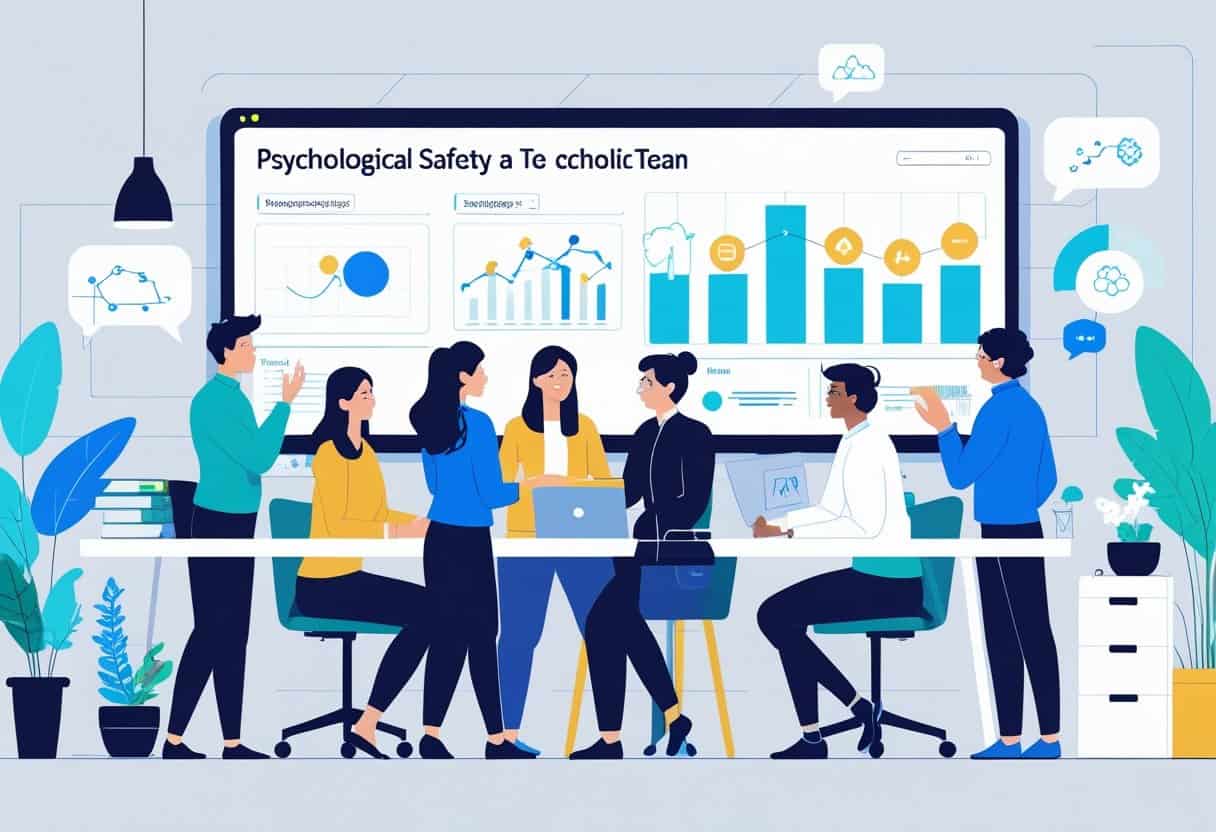
Keep tabs on psychological safety with regular surveys and by watching team behaviors. Make it part of your systems—leaders need to be accountable, and you’ve got to keep reinforcing it.
Assessing Safety: What to Measure and How
You need real data to know if your team feels safe. Psychological safety surveys usually use a five-point scale.
Key questions to ask:
- “It’s safe to take a risk on this team”
- “Mistakes are treated as learning, not blame”
- “I can raise concerns about work easily”
- “People here respect those who are different”
Run these every 6-8 weeks. Watch for team scores dipping below 3.5—those are your red flags. Track participation in meetings, ideas shared, how fast problems get raised, and turnover rates too.
Compare across teams to spot bright spots you can learn from. Share what you find within a week. Anonymous feedback is great, but only if you actually do something with it.
Making Psychological Safety Part of Your Culture
Don’t just slap “psychological safety” on a poster. Bake it into your performance systems. Add safety behaviors to what you expect from leaders and managers. Judge them by how they handle dissent and mistakes, not just survey scores.
Include safety in your quarterly business reviews, right next to revenue and delivery. According to 2022 research from Google’s Project Aristotle, teams with high psychological safety solve problems faster and have higher engagement.
Systems to update:
| System | What to change |
|---|---|
| Onboarding | Teach new hires how mistakes are handled, with real stories |
| Team rituals | Hold weekly learning check-ins—everyone shares a lesson |
| Incident reviews | Use no-blame timelines that focus on systems, not people |
| Recognition | Reward those who flag risks or challenge assumptions early |
Ask job candidates how they’ve handled disagreements or admitted mistakes. Make it clear—candor isn’t optional, it’s how you do things here.
As Amy Edmondson, Harvard professor and psychological safety expert, famously said: “It’s not about being nice. It’s about giving candid feedback, openly admitting mistakes, and learning from each other.” That’s the heart of it, really.
Overcoming Common Barriers and Pitfalls
Leaders sometimes mistake silence for agreement, or think being nice means people feel safe. If your meetings glide by without debate, chances are you’ve got a voice problem—not true alignment.
Watch for these warning signs:
- The same root causes show up in multiple post-mortems.
- One or two people always dominate discussions.
- Projects never pivot, even when new info comes in.
- People save their real concerns for hallway chats.
Status differences and power dynamics tend to squash input. Building psychological safety in the workplace means you have to fight these forces head-on. Try speaking last in debates, and make a point to invite dissent—especially from quieter folks.
Remote teams deal with extra friction. Video fatigue, awkward turn-taking, and multitasking all chip away at participation. Use chat for side input, try round-robin speaking, or co-edit docs silently to open up more ways for people to contribute.
If someone gets interrupted or dismissed, stop the meeting. Say something like, “Hold on, Alex was cut off and I want to hear the full point.” Name the behavior, not the person, and remind everyone that you challenge ideas, not people.
Frequently Asked Questions

Technical leaders run into unique hurdles when trying to build psychological safety. From measuring progress to pushing past resistance, it’s not always straightforward. Here are some practical answers about strategies, assessment, leadership, team activities, obstacles, and the real impact on performance.
What strategies can a technical leader use to foster psychological safety?
Start by modeling vulnerability. Admit when you don’t know something or when you’ve made a mistake. This lets your team know it’s okay to be honest about limits and errors.
Set clear expectations for how people should communicate. Make it obvious that respectful disagreement matters, and that speaking up isn’t just allowed—it’s expected.
Ask more questions than you answer. When someone brings up an issue, show curiosity instead of judgment. Frame your replies to invite more discussion, not shut things down.
Create safe spaces for feedback where people can share input constructively. This could be regular retros, one-on-ones, or even anonymous channels.
When mistakes happen, focus on learning. Ask, “What can we learn from this?” instead of “Who caused this?”
Recognize and thank people who speak up, even if their ideas aren’t used. Call out those who challenge assumptions or spot problems. It really reinforces that their voices count.
How can you measure and assess psychological safety at work?
Surveys help you see how safe people feel. Ask stuff like, “Do you feel comfortable sharing a different opinion than your manager?” or “Can you admit mistakes without fear?”
Track behaviors in meetings. Notice how many different people speak, how often junior folks offer ideas, and if anyone pushes back on proposals.
Look at how your team handles failures. Do people report problems quickly, or hide them? Do they volunteer what went wrong?
Check business metrics tied to psychological safety. Teams with high safety usually have better engagement, lower turnover, and submit more improvement ideas.
Regular check-ins help too. Ask people directly in one-on-ones about their comfort level.
Notice what’s not being said. If certain people never speak up or tough topics get skipped, that’s a red flag.
What role does leadership play in psychological safety?
Your behavior as a leader sets the tone. Building psychological safety takes intentional leadership that shows openness and respect, even when it’s tough.
Respond to input without getting defensive. When someone brings you bad news or disagrees, your reaction decides if they’ll ever speak up again.
Invite quieter team members to participate. Don’t assume silence means agreement or happiness.
Address unsafe behaviors right away. If someone’s rude about a colleague’s idea or punishes someone for speaking up, you’ve got to step in.
Building a culture of psychological safety means ditching command-and-control. Move from telling to asking, and from knowing all the answers to exploring questions together.
Your consistency really matters. People watch to see if you mean what you say about wanting honest feedback.
As Amy Edmondson, a leading Harvard researcher on psychological safety, puts it: “It’s not about being nice. It’s about candor, about making it possible for people to speak up.”
What are some exercises or activities that boost psychological safety?
Kick off meetings with a “failure share.” Someone talks about a recent mistake and what they learned. If you go first, it makes it easier for others to follow.
Run blameless post-mortems after incidents. Focus on what happened and how to prevent it, not who’s at fault.
Try retros like “Start, Stop, Continue.” Everyone shares what the team should start, stop, or keep doing.
Do “question storms.” The team brainstorms questions about a problem—no answers yet. It encourages curiosity and fresh thinking.
Hold “premortem” sessions before new projects. Ask everyone to imagine the project failed, then work backwards to spot risks. It makes talking about concerns normal.
Practice active listening. Team members paraphrase what others said before responding. It builds respect and makes people feel heard.
Pair programming or peer code reviews can help too. Set clear guidelines for feedback, and focus on learning together—not nitpicking.
What are the common barriers to psychological safety—and how do you break them down?
Status gaps make people nervous about speaking up to higher-ups. Flatten the field by inviting junior folks to share first in meetings.
Bad past experiences with blame make people wary. If your team’s been burned before, rebuilding trust takes time—and you have to show up consistently.
Time pressure tempts people to skip the “people stuff.” Treat psychological safety as essential, especially when you’re busy.
Perfectionism fuels fear of looking foolish. Celebrate “intelligent failures”—when someone tries something new and it flops, but you all learn something.
Lack of diversity can make underrepresented folks feel exposed. Go out of your way to make sure everyone’s voice gets equal weight.
Remote work cuts down on casual trust-building. Create intentional ways for people to connect, and make sure virtual meetings include everyone.
Competitive cultures where people chase recognition can kill safety. Reward collaboration and team wins more than individual heroics.
According to a 2022 MIT Sloan study, teams with strong psychological safety outperformed peers by up to 30% on innovation and retention metrics. Maybe it’s time we all paid a bit more attention to how people actually feel at work?
How Does Psychological Safety Really Affect Team Performance and Innovation? (2026 Guide)
Teams with high psychological safety actually report more mistakes. Oddly enough, this usually leads to better outcomes in the long run.
When people feel safe to speak up about errors early, you can catch problems before they spiral out of control. That’s a big deal for any team trying to avoid disaster.
Psychological safety enables learning behaviors like asking questions, seeking feedback, and experimenting.
These habits drive technical teams to keep improving. It’s not just theory—Google’s Project Aristotle found psychological safety was the single biggest factor behind effective teams.
Innovation? It’s risky by nature. You can’t come up with anything new if you’re scared to get it wrong or look foolish.
As Amy Edmondson, a Harvard professor and leading expert, puts it: “It’s not about being nice. It’s about giving candor and permission to fail.”
Recent 2022 research backs this up, showing teams with high psychological safety are more likely to experiment and, honestly, just try weird stuff that sometimes pays off.
So, if you want more creative ideas and fewer hidden problems, you’ve got to make it safe for people to speak up—even if it’s awkward.